
Eight years after a chemical attack killed dozens of people in Douma on the outskirts of Damascus, western defenders of the ousted Assad regime have revived claims of fakery. They insist — despite abundant evidence to the contrary — that the attack was “staged” by Syrian rebels to create a pretext for military intervention by western powers.
Their sudden renewal of interest was triggered by news that the OPCW, the global chemical weapons watchdog, has been ordered to pay compensation to Brendan Whelan, a disaffected former weapons inspector who the deniers of chemical attacks in Syria celebrate as a whistleblower.
In 2020 Whelan was censured by the OPCW, along with another former employee, for breaches of the organisation’s strict confidentiality rules.
Whelan then appealed to the International Labour Organisation (ILO), a UN agency which arbitrates on employment disputes involving international bodies such as the OPCW. He claimed the OPCW had not followed “due process” in arriving at its decision to censure him; the panel of judges agreed and awarded him 20,000 euros in “moral damages” — substantially less than the 350,000 euros he had initially been seeking.
Although the case hinged on legal arguments about the OPCW’s disciplinary procedures and was not concerned with the truth or otherwise of Whelan’s claims about Douma, defenders of the Assad regime have construed the tribunal’s ruling as endorsement of their allegations about “staged” chemical attacks.
The tribunal issued its judgment six months ago but no one seems to have noticed until April 30 when Aaron Maté, a prominent advocate of “staged attack” theories, published an article by Whelan about the ILO case and hailed its outcome as a “blow” to the “Syria cover-up”.
Piers Robinson, a former journalism professor who has spent years promoting the idea of faked chemical attacks, quickly followed suit, declaring Whelan “vindicated”. Robinson, whose portfolio of conspiracy theories also includes 9/11 and COVID, was convenor of the Working Group on Syria, Propaganda and Media, a quasi-academic group which viewed Assad not as a murderous oppressor but as a hapless victim of plotting by western powers.
Further support for Whelan in the wake of the ILO case has come from the left-wing British-Pakistani activist Tariq Ali and Mick Wallace, an eccentric Irish politician who was formerly a member of the European Parliament.
Whelan’s role
Whelan was a member of the OPCW’s Fact-Finding Mission (FFM) sent to establish what happened in Douma. Since he had not done the required training for a deployment in the field, he was not allowed to go to Douma itself. Consequently he remained at the OPCW’s office in Damascus where, among other things, he began work on a draft report of the FFM’s findings — which led to him becoming embroiled in internal disputes about its content.
The initial draft, written mainly by Whelan, ran to more than 100 pages but left several important questions unresolved — with the result that OPCW chiefs decided to release parts of it in the form of a 34-page Interim Report and to hold back the rest pending further analysis.
In the circumstances there was nothing particularly odd about this decision but sceptics accused the organisation of suppressing evidence. According to the OPCW, though, Whelan and other FFM members involved in drafting the Interim Report — had “expressly confirmed in writing” that they agreed on the version eventually released in June 2018.
Whelan left the OPCW later that year when his contract expired. In March 2019, six months after his departure and eight months after the Interim Report was published, the FFM issued its Final Report. Most of the allegedly suppressed material from Whelan’s draft was addressed there in the light of further research and deliberation, and the report found “reasonable grounds” to believe a toxic chemical had been used as a weapon. It concluded that “this toxic chemical contained reactive chlorine” and “the toxic chemical was likely molecular chlorine” [i.e. chlorine gas].
The FFM’s brief was limited to establishing whether a chemical attack had taken place: it was not allowed to consider who might have been responsible. However, a subsequent report in 2023 by the OPCW’s Investigation and Identification Team blamed the Douma attack on “at least one Mi-8/17 helicopter of the Syrian Arab Air Force, departing from Dumayr airbase and operating under the control of the Tiger Forces”.
A leaked document
A couple of months after the FFM’s Final Report appeared, the Working Group on Syria, Propaganda and Media published a leaked 15-page document authored by Ian Henderson, another OPCW employee.
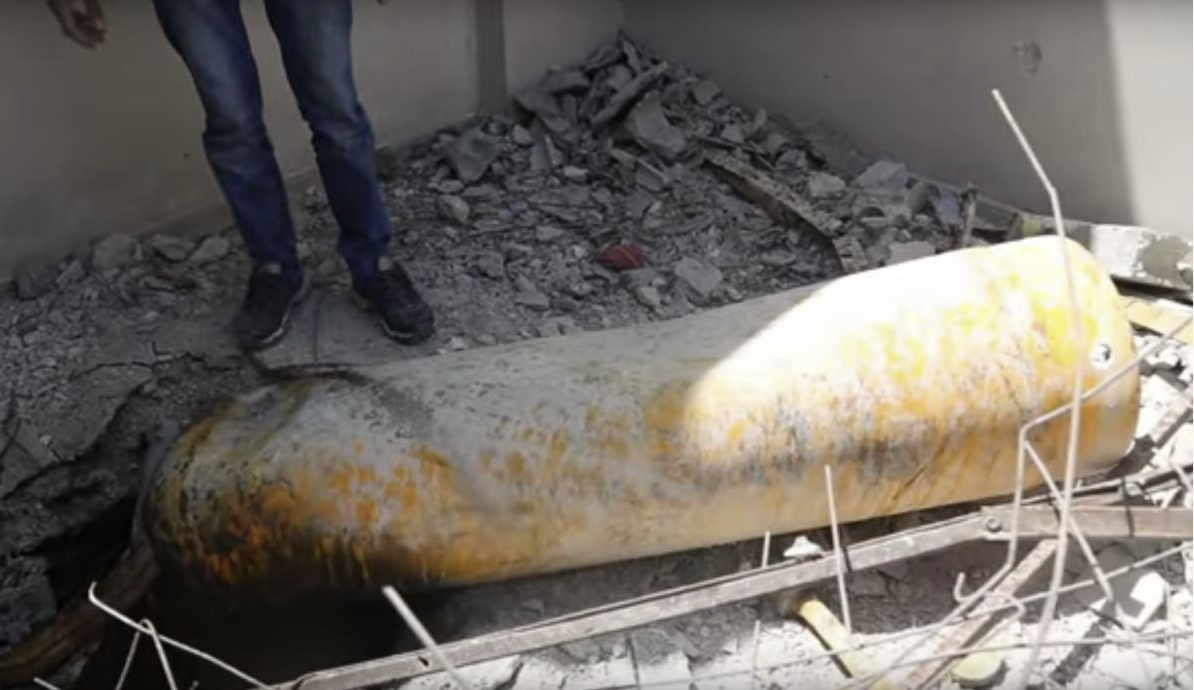
Henderson — apparently acting on his own initiative without formal approval — had carried out a study of two yellow-painted gas cylinders implicated in the Douma attack. Photos suggested both cylinders had been dropped from the air. One lay on a bed after apparently crashing through a roof and bouncing off the floor. The other was on a balcony/patio where it had apparently pierced a hole into the room below.
Henderson claimed the cylinders were more likely to have been “manually placed” than dropped from the air — with the obvious implication that rebels had positioned them to fake the appearance of a chemical attack.
When presented with Henderson’s document, the OPCW’s reaction was that it impinged on questions of responsibility for the attack which fell outside the FFM’s mandate. For that reason, he was told to pass it to the newly-established Investigation and Identification Team which had been set up specifically to identify “the perpetrators of the use of chemical weapons” in Syria.
Although Henderson’s document talked only of probabilities and offered no firm conclusion, activists on social media treated it as confirmation that Douma was an elaborate hoax by rebel fighters. Among the Assad regime’s defenders the fact that the final report made no mention of Henderson’s conclusions was seen as evidence of a cover-up. In a commentary on the leaked document the Working Group claimed it was now “beyond reasonable doubt” that the alleged chemical attack in Douma had been staged.
Two days after the leaked document appeared on the internet (and shortly before his employment contract was due to end) Henderson was suspended and escorted out the OPCW headquarters in what Whelan later described as “a less than dignified manner”. The organisation then launched an internal investigation into “possible breaches of confidentiality”.
[For a full account of the Henderson affair see chapter 12 of my e-book, ‘Denying the Obvious’.]
The importance of confidentiality
Confidentiality is an issue that the OPCW takes extremely seriously. Its rules and regulations forbid employees from speaking to the media, giving talks or writing about their work without permission. Internally, they can only discuss their work with those colleagues who have a need to know and, even after leaving the OPCW they are not allowed to disclose any information gleaned while working there unless it has already been made public.
Confidentiality was central to the FFM’s investigations and was seen as a way to safeguard their integrity and independence. Witnesses remained anonymous for their own protection and experts consulted by the FFM were not identified either — again, with the intention of protecting them and preventing any interference from outside.
High levels of confidentiality meant low levels of transparency — but the OPCW had been conceived on the basis that transparency wasn’t necessary: the scientists it employed were fully qualified for their tasks and the experts it consulted were the best available: they didn’t need to explain how they reached their conclusions, because they could be trusted.
In connection with the Syria investigations, this left the OPCW in an exposed position. Populist currents were dismissive of experts and the lack of transparency gave activists on social media plenty of scope to use their imagination. One result was the emergence of an alternative narrative which accused the OPCW of cherry-picking evidence in order to reach a “pre-ordained” conclusion.
Russian mischief
At the same time the OPCW was facing internal challenges from one of its own members: Russia, which as Assad’s main ally, was actively seeking to undermine the Syria investigations.
Ever since the sarin attack on Ghouta in 2013, Russia had made a point of adopting and amplifying claims of fakery by rebel fighters, regardless of credibility. Russia didn’t care whether they were true or not: its purpose was to muddy the waters and make people unsure what to believe.
In April 2018, four Russian intelligence agents were caught trying to hack into the OPCW’s wifi system from a car park next to its headquarters in the Netherlands, and according to Director-General Fernando Arias this was not the first time the OPCW had been targeted.
A day after the car park incident foreign minister Lavrov made a dramatic claim which appeared to exonerate Russia of involvement in the poisoning of Sergei and Yulia Skripal. Reading from a confidential lab report produced for the OPCW’s Skripal investigation, he said “traces” of BZ had been detected— a chemical that incapacitates people but is not normally lethal. Based on that, Lavrov suggested the Skripals had been poisoned with BZ rather than a Novichok nerve agent as Britain and the OPCW maintained.
Russia’s Sputnik News noted that BZ had been developed by a Swiss pharmaceutical company in 1951 and later used in the armed forces of the US, Britain and other Nato member states. “More importantly,” it said, “BZ has never been produced in the Russian Federation or on the territory of the USSR.” It also pointed out that the OPCW’s report on the lab tests had “not made a single reference” to the discovery”.
While it was true that the lab had detected BZ, there were good reasons for ignoring it. A few days later the OPCW explained that the BZ had no connection with the Skripals: it was part of a control sample to check that the labs were doing their job properly. Russia had jumped to the wrong conclusion about its significance.
There were also indications that Russia had access to Henderson’s leaked document before it appeared on the Working Group’s website in May, 2019. On 26 April, Russia had sent a letter to the OPCW criticising its Interim Report on Douma and making a series of points about the cylinders that were remarkably similar to those made by Henderson.
Stirring the pot
Despite having left the OPCW, Whelan was still stirring the pot. He continued to approach staff “to discuss confidential information regarding the Douma investigation that was classified as Highly Protected”, according to the OPCW.
In October 2019 he surfaced in Brussels claiming to have emails, text messages and “suppressed draft reports” showing irregularities in the conduct of the Douma investigation. Identified only by the pseudonym “Alex”, he claimed that evidence from Douma had been manipulated to reach a “pre-ordained” conclusion.
In what appeared to be a flagrant breach of the confidentiality rules, Whelan presented his evidence at a meeting with an invited panel whose composition ensured he would be given a sympathetic hearing. They unanimously declared themselves convinced by his presentation and issued a two-page statement outlining their belief that the conclusions of the FFM’s Douma report were flawed and bore little relation to the facts. The panel went on to call for everyone involved in the investigation to “come forward and report their differing observations in an appropriate forum of the States Parties”.
Whelan’s presentation and the publicity surrounding it had been orchestrated by the Courage Foundation, an organisation closely linked to WikiLeaks. Its stated aim was to support “truthtellers” but a surprisingly large number of its leading figures also disputed the chemical attacks in Syria and favoured a variety of other conspiracy theories.
One prominent member of the Courage Foundation was former British spy Annie Machon. After resigning from the intelligence service she had gone on to organise a 9/11 “truth campaign”. Following Alex’s presentation, Machon appeared on Russia’s RT channel calling for a “new inquiry” into the events in Douma.
Although Alex was said to be in possession of supporting documents, a month passed without any sign of them. The first one appeared online towards the end of November and was followed by nine more at intervals over the next few weeks — all published by WikiLeaks.
The ensuing wait for Whelan’s evidence made independent scrutiny of his claims difficult, but it didn’t prevent his supporters from treating them as established fact. In the meantime, Whelan’s original draft report on Douma acquired almost mythical status as a source of suppressed truths: according to claims on social media it been “redacted”, “doctored” and “censored”.
Before the draft was leaked, Whelan himself had also fuelled the hype surrounding its alleged contents. He was reported as claiming the draft described Douma as “a non chemical-related event”, when it actually said “a non chemical-related incident” was one of the possibilities considered in connection with the reported deaths — and on which the FFM had reached no authoritative conclusion. Whelan’s draft had also not ruled out a chemical attack.
[For a more detailed account of Whelan’s activities see chapter 13 of my e-book, ‘Denying the Obvious’.]
Investigating the leaks
During the OPCW’s investigation into “possible breaches of confidentiality”, 29 people — current and former staff, plus some from outside the organisation — were interviewed as witnesses. Henderson and Whelan were also invited for interview but Henderson declined and Whelan responded with a series of questions and demands about procedural matters and the scope of the investigation.
The resulting report of the investigation, in Febuary 2020, accused both Henderson and Whelan of “deliberate and premeditated breaches of confidentiality”, though in order to “safeguard their due process rights” it didn’t name them. Instead, it referred to them only as “Inspector A” and “Inspector B” respectively, though by that stage their identities were well known both inside and outside the OPCW.
Briefing OPCW member-states on investigation’s findings, Director-General Arias said: “Inspectors A and B are not whistleblowers. They are individuals who could not accept that their views were not backed by evidence. When their views could not gain traction, they took matters into their own hands and breached their obligations to the Organisation. Their behaviour is even more egregious as they had manifestly incomplete information about the Douma investigation. Therefore, as could be expected, their conclusions are erroneous, uninformed, and wrong.”
Regarding Whelan (“Inspector B”), the report concluded that he had “violated his obligations concerning the protection of confidential information due to his unauthorised disclosure of confidential information to individuals who did not have a need to know such information”. It added that “he failed to comply with the specified procedures for the handling, protection, release, and dissemination of confidential information so as to create a clear risk of unauthorised disclosure”.
Whelan had also been suspected of leaking Henderson’s document to the Working Group on Syria, Propaganda, and Media but the report found “insufficient evidential basis” for that.
In awarding damages to Whelan, the ILO tribunal appears to have called for the investigation report to be withdrawn — not because there’s anything wrong with its conclusions but because of laws in the disciplinary procedure. At the time of writing, though, the report can still be found on the OPCW’s website.
Back to Syria
Meanwhile, the flurry of recycled claims attempting to discredit the OPCW that has been triggered by the ILO’s ruling is unlikely to be the last, because the fall of the Assad regime has given the organisation’s investigations in Syria a new lease of life.
By the time Assad fled to Russia in December 2024 the Syrian regime had long ceased cooperating with chemical weapons investigators in any meaningful way. Now, though, with a more cooperative regime in Damascus there’s hope that a fuller picture of Assad’s illicit chemical activities will emerge and that some, at least, of those who carried out chemical attacks will eventually be held accountable.
Syria joined the Chemical Weapons Convention in 2013 under international pressure after being blamed for a nerve agent attack which killed hundreds in rebel-held Ghouta. Under the Convention’s rules Syria then had 30 days to declare all its chemical weapons and related facilities. All the declared chemicals were destroyed but subsequent chemical attacks, plus discoveries by OPCW investigators, showed the declaration was far from complete.
More than 12 years later, despite amendments to the regime’s original document, the OPCW has still not certified the Syrian declaration as complete and accurate. There are currently 19 “outstanding issues” which the OPCW describes as serious because they involve “large quantities of potentially undeclared and/or unverified chemical warfare agents and chemical munitions”. These all need to be resolved in order to finalise the declaration.
The Assad regime had declared 26 locations related to chemical weapons activity but the OPCW says it has since been informed that more than 100 additional locations may have been involved. The list is said to include military facilities, airfields, and research centres.
Since March 2025, investigators have visited more than 20 of these suspect locations and collected samples for analysis. They have also “held a number of meetings with the Syrian authorities, and conducted multiple rounds of interviews with former chemical weapons experts”, according to the latest monthly update. At least four of the visited locations “could be declarable” under the Chemical Weapons Convention, it says.
Meanwhile, the Syrian authorities are investigating the reported disappearance of 75 cylinders from a location in the Aleppo area. They have also handed over to the OPCW 37 sealed cardboard boxes containing more than 50,000 pages of documents which are now being analysed.