Banned chemical weapons have been used repeatedly during the Syrian conflict and the obvious conclusion to be drawn from the evidence is that in most cases, if not quite all of them, the Assad regime was responsible.
We know, for example, that the attacks almost always struck rebel-held areas. We know too that some of the chemical weapons were designed to be dropped from the air, and that rebel fighters – unlike the regime –had no aircraft. In addition to that, while the regime admits it had stockpiles of the nerve agent sarin there's no credible evidence that the rebels had any.
Over the last five years investigators from the Organisation for the Prohibition of Chemical Weapons (OPCW) have compiled a series of reports based on multiple sources – laboratory tests of samples, medical reports, witness statements, photos and videos as well as some on-the-spot inspections. Although their brief did not allow them to apportion blame, their reports leave little room for doubt that the Assad regime used both sarin and chlorine.
That hasn't stopped the regime from denying any involvement and it has been supported in this denial by its chief ally, Russia, along with various fringe websites and "anti-imperialist" elements on social media.
One tactic adopted by the deniers is to distract attention from the evidence by claiming the regime had no motive for resorting to chemical weapons – that they served no useful military purpose and, even if they did, the regime would not have dared to use them for fear of the international consequences.
But if the regime didn't do it, that still leaves the question of who was using chemical weapons in Syria – and the explanation from Assad's propagandists is that rebels were somehow fabricating the attacks and making them look like the work of the regime in the hope that western powers would then respond by toppling Assad.
The origins of this idea can be traced back to August 2013 when hundreds of people in Ghouta, a rebel-held area on the outskirts of Damascus, were killed by the nerve agent sarin.
Shortly afterwards, a website with links to Iran and Hizbullah claimed that news reports of the attack and YouTube videos of the dead and injured had been posted on the internet several hours beforehand. This, it said, showed "that the terrorists massacred people then recorded the scenes to deceive people of the world" but in their rush to spread the story had given themselves away by releasing the videos prematurely.
It was an absurd claim and although it was was proven wrong almost immediately, Assad's chief ally, Russia, insisted it was evidence of a plot to discredit the regime.
This set a pattern for subsequent chemical attacks, dozens of which were reported over the next five years. Allegations of fakery and false flags became a constant theme of the Russian and Syrian governments, supported by various fringe websites and "anti-imperialist" elements on social media.
9/11 truthers
A closer look at the people circulating these ideas (other than the Russian and Syrian governments) shows they usually have a conspiratorial view of the world and often favour improbable explanations for events outside Syria too.
For example, the "Working Group on Syria, Propaganda and Media" not only defends the Assad regime against accusations of using chemical weapons but also disputes Russia's use of a nerve agent against Sergei and Yulia Skripal in Britain last year. Of the six "briefing notes" published on its website, three are about the Skripal affair (here, here and here).
The group's advisory board includes Mark Crispin Miller, a professor at New York University who is a long-standing 9/11 truther. Miller's views appear to be shared by the group's convenor, Piers Robinson, a former professor at Sheffield University. Last year Robinson wrote a review of a book by two 9/11 truthers, describing it as a "diligent and painstaking work". His name appears on the book's back cover, endorsing it as "authoritative and carefully argued".
Robinson, who until recently worked in the university's journalism department, is often quoted on the Russian propaganda channels, RT and Sputnik, but is sceptical of mainstream media in the west, accusing them of constantly manipulating the public.
Elaborating on this theme of western media trickery in his inaugural lecture at Sheffield University, he recalled the occasion in 2003 when President Bush stood in front of a banner saying "Mission Accomplished" and announced the end of major hostilities in Iraq. To general astonishment, Robinson told his audience the "Mission Accomplished" banner "wasn't actually there" – it had been superimposed in all the press photos and TV coverage.
Needless to say, his claim was nonsense but it's a good example of the conspiratorial mindset found among those who claim rebels faked the chemical attacks in Syria. If a story suits the political narrative, implausibility is no obstacle to believing it.

Concocting a narrative
The claims that Assad wouldn't use chemical weapons for fear of the consequences, and that rebels sought to incriminate him by making it look as if he did, are rooted in a broader propaganda narrative – a narrative which characterises Syria as a victim of western imperialism and disregards the public's grievances that triggered the conflict during the Arab Spring protests of 2011.
The conflict in Syria is presented as the latest in a series of "pre-planned regime-change wars" – basically a repeat of the war in Iraq that overthrew Saddam Hussein. This, of course, assumes that western powers had learned nothing from the quagmire in Iraq.
Although there were plenty of signals from Washington and other western capitals were that the Iraq experience had made them wary of getting deeply involved in Syria, the propagandists maintained that western powers were just waiting for a suitable pretext – which the rebels were trying to provide by faking chemical attacks and blaming the regime for them.
Analogies with Iraq
The analogy with Iraq didn't bear serious scrutiny but it allowed Assad's defenders to draw a parallel between weapons of mass destruction in Iraq and chemical weapons in Syria.
False claims about Saddam's weapons programme had been used as the excuse for invading Iraq and, based on that, it was easy to suggest that the chemical weapons issue in Syria was a similar example of deception, cooked up for a similar purpose.
A look at the historical context, though, shows that Iraq and Syria were two very different cases as far as relations with the west were concerned. Iraq had been a constant international preoccupation ever since its invasion of Kuwait in 1990. UN sanctions and weapons inspections imposed as a result of that led to years of wrangling. Long before the invasion of Iraq in 2003 the US had made no secret of its intentions towards Saddam Hussein and steadily escalated the propaganda campaign against him. Regime change in Iraq had been official American policy since 1998.
Syria, in the other hand, was viewed as something of a nuisance but not a major concern among western governments or foreign policy analysts apart from a short period around 2005-2006 during the Lebanon crisis.
Befriending Bashar
When Bashar al-Assad inherited the presidency from his father in 2000, European countries saw a chance improved relations. In 2001 Tony Blair became the first British prime minister to visit Syria in more than 30 years. It didn't go well, but a few months later Bashar and his wife were welcomed in Britain on an official visit which included an audience with the queen.
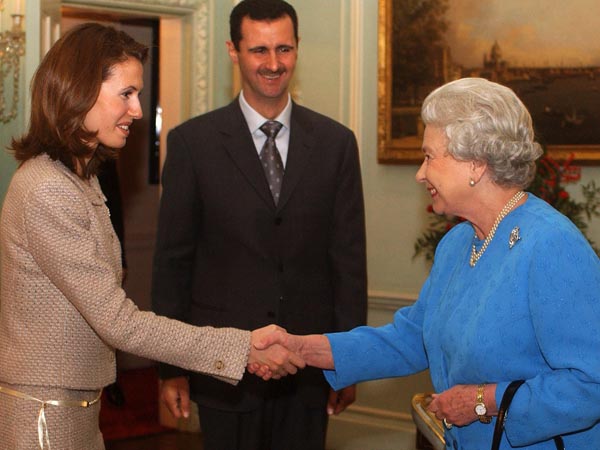
There was more royal approval in 2003 when the king and queen of Spain paid a state visit to Syria – the first since Juan Carlos had come to the throne in 1975.
Syria and the EU also began negotiating an Association Agreement aimed at developing trade along with cooperation in other areas. Though the agreement was never signed, by 2011 the EU had become Syria's fourth largest trading partner after Iraq, Saudi Arabia and United Arab Emirates.
This is not to suggest that relations between Europe and Syria were good. They were often problematic but the general feeling was that they could be handled by diplomatic means.
US relations with Syria were strained, though nowhere near as bad as they had been with Iraq. American concerns revolved mainly around terrorism. In Washington, Syria was viewed as a problem, though not an unmitigated one.
Since 1979 Syria had been designated by the US as a state sponsor of terrorism and in 2003 Congress passed the Syria Accountability and Lebanese Sovereignty Restoration Act. Instigated mainly by supporters of Israel and passed in the face of opposition from President Bush, this sought to penalise Syria for keeping its forces in Lebanon and backing militant groups opposed to Israeli occupation. The Act also called on Syria to stop developing weapons of mass destruction and end illicit trade with Iraq but contained no threat of military action and made no mention of regime change in Syria.
However, the Syrian and American positions were not always diametrically opposed. Following Iraq's invasion of Kuwait in 1990, for example, Syria had provided about 20,000 troops for the US-led coalition in Operation Desert Storm. In 2002, as a non-permanent member of the UN Security Council, Syria had also voted in favour of Resolution 1441 – instigated by the US and Britain – which declared Iraq to be "in material breach" of several earlier resolutions and threatened "serious consequences" if its "violations" continued.
On the counter-terrorism front, a State Department report in 2005 noted that while Syria supported some armed groups such as Hizbullah it had cooperated with the US and other foreign governments "against al-Qaeda and other terrorist organisations and individuals".
The overall picture, then, was of a somewhat fraught relationship beween Syria and western governments which had both ups and downs. But contrary to the narrative propagated today by Assad's supporters, it was one that western powers saw as manageable without resorting to extreme measures. If the Arab Spring protests had not spread to Syria in 2011 and had not been met with a vicious response from the regime it's very likely that Assad's relations with the west would have been plodding along on the same bumpy road that we saw during the decade before the conflict broke out.
The Ghouta massacre
The huge number of casualties when sarin-filled rockets hit Ghouta in August 2013 caused international shockwaves. According to the Assadists' propaganda narrative, this should have been the perfect excuse for western powers to launch the Iraq-style regime-change war they were supposedly longing for. In the event, though, they dithered about what to do.
A year earlier, President Obama had warned that chemical weapons were a red line as far as the US was concerned. At the time he did not elaborate on what would happen if the line was crossed, apparently hoping that his words would be enough discouragement, and when the Ghouta attack occurred it put him on the spot.
While supporting opposition to Assad inside Syria, Obama had been reluctant to commit American forces directly – and this was broadly in line with public opinion which showed little appetite for war.
In considering the options Obama insisted that any action over Ghouta should focus on chemical weapons rather than the wider war. "The world has an obligation to make sure that we maintain the norm against the use of chemical weapons," he said, adding:
"In no event are we considering any kind of military action that would involve boots on the ground; that would involve a long-term campaign. But we are looking at the possibility of a limited, narrow act that would help make sure that not only Syria, but others around the world, understand that the international community cares about maintaining this chemical weapons ban and norm."
Even with this limited objective, Obama found himself struggling to gain approval from Congress. Meanwhile in Britain the Cameron government's plans to take part in any US-led military action were rejected by parliament.
The situation was eventually defused when Syria agreed to join the Chemical Weapons Convention and dismantle its stockpile along with related equipment and production facilities.

Rebels undeterred?
The Ghouta crisis was the strongest indication yet that western powers – contrary to the claims of Assad's defenders – were not eager for military action in Syria. That was obvious to everyone, including Assad and the rebels. Its message to Assad, if he was behind the attack, was that he had got away with it once and could probably do so again. And it told the rebels, if they were behind it, that their plan had failed.
If rebels were indeed responsible this should have caused them to wonder whether, after failing to get the desired result from Ghouta, there was any point in trying again.
According to the propaganda narrative, though, the rebels were undaunted. Over the next four years, dozens more chemical attacks were reported in Syria. Most were barely noticed in the outside world and if the rebels were really behind them it's hard to see why they persisted for so long, to so little effect.
Among the many reported chemical attacks, only two (Khan Sheikhoun in 2017 and Douma a year later) resulted in western airstrikes. These were limited in scope, targeting regime facilities associated with the attacks, and didn't assist the rebels directly.
From sarin to chlorine
There's another puzzle in the wake of Ghouta, because most of the attacks reported subsequently involved chlorine rather than sarin. The choice of chlorine makes little sense if the rebels were using chemicals to entice western powers into the war: it would mean that what they had failed to achieve in Ghouta with a nerve agent they were now trying to achieve with a less deadly chemical that generally had less shock value.
The choice of chlorine makes little sense if the rebels were using chemicals for "provocation" purposes – as a political rather than military weapon, and it makes even less sense if, as Assad and others have claimed, the rebels aleady had access to sarin.
The choice of chlorine becomes more explicable, however, if it was being used by the regime rather than rebels. The first reported chlorine attacks – in April 2014 – came just a few months after Syria agreed to join the Chemical Weapons Convention and began destroying its stocks and production facilities under the OPCW's supervision. Chlorine, unlike sarin, was not part of that process. There was no obligation to declare it to the inspectors because in normal circumstances chlorine it is not regarded as a chemical weapon.
Under an annex to the Convention, some substances – such as nerve agents – are specifically designated as chemical weapons on the grounds that they are unlikely to be produced for legitimate purposes. Chlorine, on the other hand, has so many legitimate uses that possesssing it is not, in itself, forbidden by the Convention. It does, however, become a banned weapon if produced or used with the intention of causing "death, injury, temporary incapacitation or sensory irritation through its chemical action".
The result of this was that while the regime made a show of cooperating with the OPCW with regard to designated chemicals, it still had chlorine as a readily available alternative.
Aside from availablility, there are a couple of reasons – if the regime was behind the attacks – for preferring chlorine over sarin. Its lesser shock value meant that using it was likely to attract less international attention. At the same time, it was still a nasty weapon and had the militarily useful effect of making people flee.
The other advantage was that chlorine attacks were easier to deny. Sarin leaves distinctive chemical traces but laboratory tests from the scene of a chlorine attack don't provide conclusive proof. There may be other evidence, such as witness statements, the symptoms of victims and remains of munitions, but while laboratory tests may point to chlorine use they cannot confirm it absolutely. The problem is that chlorine is a very common element – which makes it difficult to distinguish between chlorine released in a chemical attack and chlorine that already exists in the environment.
Why use chemical weapons?
Syria had long been suspected of developing chemical weapons and at the time of the Ghouta attack was one of only four countries worldwide which had neither signed nor ratified the Chemical Weapons Convention. The first public admission that it did have chemical weapons came in July 2012 when foreign ministry spokesman Jihad Makdissi said they were "in storage" and would only be used if Syria was "exposed to external aggression". They would not be used inside Syria, he said, "no matter what the developments" in the conflict.
The regime, though, was in the midst of a battle for survival and from a military standpoint there were situations where chemical weapons could be useful. In urban combat they offered a way to clear out pockets of resistance without the need to fight at close quarters – thus minimising casualties among the regime's forces.
Another military consideration was that the rebels were making extensive use of tunnels and other underground facilities because of the protection they offered from conventional weapons. Chemical weapons, however, could penetrate such places more easily. Chlorine gas and sarin vapour would seep down into them, since both are heavier than air.
In addition to these battlefield uses, chemical weapons have a powerful psychological effect which can be exploited to intimidate and demoralise civilians in enemy-held territory. Saddam Hussein used them in that way against rebellious Iraqi Kurds in the 1980s and there are indications that the Assad regime was doing so too.
For example, a report by Human Rights Watch in 2017 noted that some of the chemical attacks "hit residential areas far from the frontlines without any obvious military target and appear to have killed and injured only civilians". Attacks of that kind have been interpreted as part of a counter-insurgency strategy adopted by the regime – known as the "enemy-centric" approach – which punishes the inhabitants in areas where insurgents are active.