Search
Principles on Freedom of Information Legislation
These principles set out standards for national and international regimes which give effect to the right to freedom of information. They are designed primarily for national legislation on freedom of information or access to official information but…
The press in the Arab world:
100 years of suppressed freedom
by Said Essoulami
The history of press freedom in the Middle East and North Africa in the last century is determined by the interaction of several political, economic, social and technological factors. Among the most important of the…
Development and growth of the internet
The Arab countries lagged behind most of the world in adopting the internet. One factor, until the late 1990s, was the technical difficulty of using Arabic on the internet (and on computers more generally) which tended to restrict use to those who could work…
Overview
NEWSPAPERS: Newspapers in the Arab countries can be divided into three categories: those that are government-owned (together with semi-official papers such as al-Ahram in Egypt), those owned by political parties, and the “independent” press. In general, Arab governments seek to restrict…
Organisations
Committee to Protect Journalists
An independent organisation based in New York which promotes press freedom worldwide "by defending the rights of journalists to report the news without fear of reprisal". See Middle East overview.
Reporters Without Borders
(Reporters Sans Frontières)…
International codes of practice
ASEAN - 1989
Council of Arab Information Ministers - 1978
Federation of Arab Journalists - 1972
International Federation of Journalists - 1986
Islamic Media Conference - 1980
UNESCO - 1983
Arab codes
Algeria - 2000
Egypt - 1972
Egypt - 1983
Iraq - 1969
Lebanon -…
Copyright is meant to prevent unauthorised copying of creative works. It applies towritten, artistic and musical works - including computer software. The aim is to ensure that the creators of these works, or those who own the rights to them, receive a fair reward.
Historically, Arab countries have…
The Arab League Satellite Broadcasting Charter
In 2008, at a meeting called by Egypt and Saudi Arabia, Arab information ministers approved a charter to regulate satellite broadcasting. This was widely viewed as an attempt to assert control over the medium.
Arab League Satellite Broadcasting Charter…
Newspapers in the Arab countries can mainly be divided into three categories: those that are government-owned (together with semi-official papers such as al-Ahram in Egypt), those owned by political parties, and the “independent” press.
Very few of the privately-owned newspapers can be considered…
Growth patterns, 2000-2008
Country
Population
Users 2000
Users 2008
% of total
Increase
Penetration
Algeria
33,769,669
50,000
3,500,000
9.13%
6900%
10.4%
Bahrain
718,306
40,000
250,000
0.65%
525%
34.8%
Comoros
731,775
1,500
21,000
0.05%…
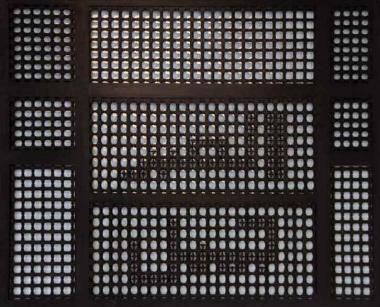
ARAB ART ONLINE: Susan Hefuna: Al Sabr Gamil (Patience is Beautiful) 2007. Ink stained on wood 140 x 170 cm. More information | Click to enlarge