
Since the fall of the Assad regime more information has been emerging about the extent of Syria’s non-compliance with the Chemical Weapons Convention but now a UN agency has also accused it of undeclared nuclear activities, in breach of the Non-Proliferation Treaty.
According to a leaked report by the International Atomic Energy Agency, the former regime “failed to report nuclear material, facilities and activities as required under the NPT Safeguards Agreement”. These included a nuclear reactor under construction in Deir ez-Zour, a fuel fabrication plant and another site used for fuel storage.
The construction work in Deir ez-Zour first came to public attention in 2007 when eight Israeli F-15 bombers entered Syrian airspace and reduced the site to rubble.
Commercial satellite pictures taken shortly before the attack showed a large square building capable of housing a nuclear reactor. There was also a smaller secondary building nearby and a number of vehicles could be seen in the picture.
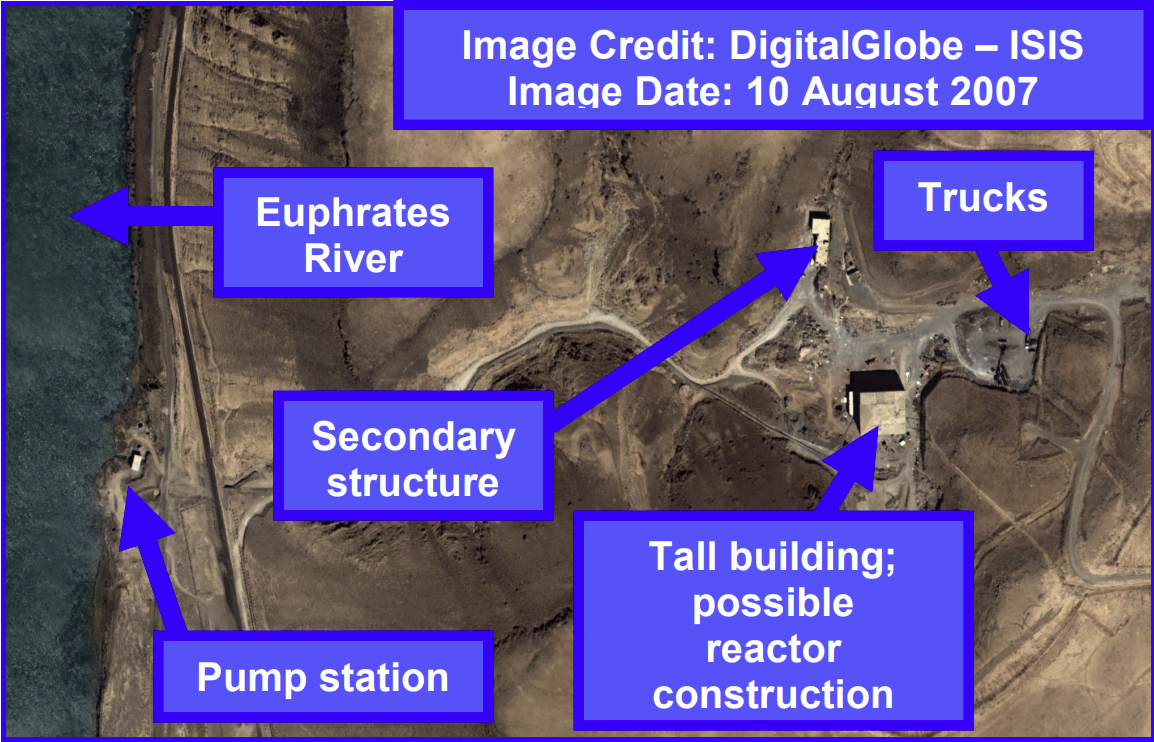
Less than a kilometre away, on the banks of the Euphrates, was another small structure thought to be a pumping station to provide cooling water for a reactor.
The shape and dimensions of the suspected reactor building were very similar to those of a known reactor in North Korea, and the North Koreans were believed to be assisting the Assad regime in its covert nuclear programme.
Several weeks after the bombing, President Bashar al-Assad said the site was a building “related to the military”.
“It’s under construction so there’s no people in it, there’s no army, there’s nothing in it and we do not know the reason … We are not interested in any nuclear activity,” he told the BBC. He added that site did not have “any protection, any air defence” and that after the attack there was “no radiations, no emergency plans”.
However, Syria’s behaviour after the Israeli attack also suggested it had something to hide. It cleared up the remains very quickly and journalists were not invited to visit the site — which would have been an easy way to allay suspicions if its purpose had been innocent.
After Assad fled to Russia the new Syrian government agreed to give IAEA inspectors access to suspected former nuclear sites.
In its latest report, following a visit to Deir ez-Zour last month, the IAEA said: “Based on observations made at the location, the agency confirms that the cooling infrastructure which has now been uncovered is consistent with that of a nuclear reactor.”
This follows a IAEA report last year saying uranium particles had been found in samples taken from the site. Excavations in the area are continuing.