Search
Chapter 6: Atheism, gender and sexuality
THROUGHOUT human history, religions have usually been dominated by men: male prophets, male clerics and male theologians, not to mention a male God. Women, meanwhile, have usually been expected to sit back and listen to them. While some churches in the west…
Chapter 5: Losing their religion
ATHEISM is a response to religion, and without religion no one would bother to become an atheist. Without religion, God would be an unknown concept and there would be no particular reason for anyone to question His existence; belief and disbelief would both turn…
Chapter 4: Fear of disbelief
IN SAUDI ARABIA all citizens are officially Muslims whether they like it or not, and the practising of other religions is forbidden. The image usually projected by the Saudi authorities is of a thoroughly devout country – so devout that shops have to close at prayer…
Chapter 3: God’s own book
IN ORDER to attract followers, religions need some way of demonstrating their divine credentials. Christianity has traditionally relied on the stories of miracles performed by Jesus – turning water into wine, casting out demons, healing the sick with his touch, etc –…
Chapter 2: Atheism in Arab history
THE ARABIC language has no exact equivalent of the English word “atheist”. While “atheist” is derived from ancient Greek (a- meaning “without”, theos meaning “god”) and clearly refers to non-belief in God or gods, the Arabic terms normally used today – mulhid for…
Chapter 1: Denying God, subverting society
IN THE PALESTINIAN town of Qalqilya, 25-year-old Waleed al-Husseini hit on an amusing if irreverent idea. He decided it was time for God to have a Facebook page – and set about creating one. He called it Ana Allah (“I am God”) and announced jokingly that…
Introduction
ARABS, in popular imagination, are assumed to be Muslims and potential religious fanatics. The reality is a lot more complex. Islam is far from monolithic and has many strands: Sunni, Shia, Salafi, Wahhabi, Zaidi, Sufi, Alawi, Ibadi, Isma’ili and others. Nor are Arabs necessarily…
It's increasingly clear that the hacking incident last May which created a pretext for the Saudi-Emirati confrontation with Qatar was not a random attack: it had been carefully planned and took more than a month to prepare. This is a significant development because it suggests that the resulting…
Egypt faces multiple security threats, with the continuing Islamist insurgency in Sinai and the bombing of churches not least among them. But the latest threat detected by the ever-vigilant Sisi regime comes from a different direction – from researchers doing surveys.
Last November the regime …
The banned nerve agent sarin has been used repeatedly in the Syrian conflict, as laboratory tests have confirmed. There are disputes, though, about who has been using it. Syrian rebels, along with western governments, blame the Assad regime while the regime, supported by Russia and Iran, blames the…
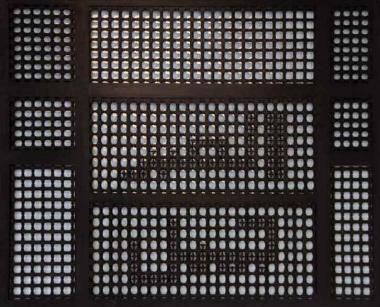
ARAB ART ONLINE: Susan Hefuna: Al Sabr Gamil (Patience is Beautiful) 2007. Ink stained on wood 140 x 170 cm. More information | Click to enlarge